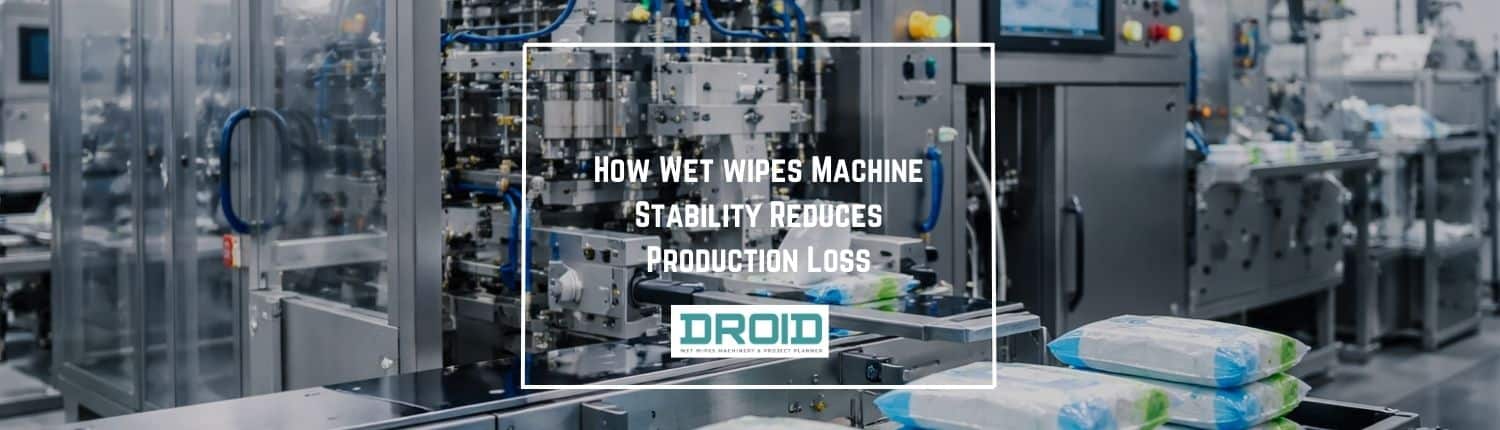
• How Wet Wipes Machine Stability Reduces Production Loss - How Wet Wipes Machine Stability Reduces Production Loss

How Wet Wipes Machine Stability Reduces Production Loss

The stability of your wet wipes machine during actual operating conditions is crucial for determining production efficiency in the wet wipes manufacturing industry, and it’s not solely about speed. Many manufacturers often overlook machine stability in favor of flashy metrics like cuts per minute or packs per minute. However, one of the primary, though rarely mentioned, causes of production loss is instability, which can negatively impact long-term profitability, productivity, and product quality.

A stable manufacturing line for wet wipes ensures consistent product quality, minimal downtime, and uninterrupted operation. Investing in the stability of wet wipes machines is essential for manufacturers looking to reduce the cost per wipe and maximize their return on investment.

Reduced Unplanned Downtime

One of the most costly and disruptive issues in wet wipes production is unplanned downtime, often caused by machine instability rather than significant mechanical breakdowns. Even minor vibrations or irregularities can lead a wet wipes machine to stop if it lacks structural rigidity or precise synchronization. These disruptions can result from sensor misalignment, erratic material feeding, or fluctuations in motion-control systems, all of which disrupt production continuity. Though these stoppages may seem minor, they accumulate and result in substantial productivity and efficiency losses.

To mitigate these risks, a robust wet wipes manufacturing line ensures continuous coordination among critical activities, including cutting, folding, dosing, and packing. With a sturdy frame and advanced motion control systems, the machine operates smoothly even at high speeds, minimizing the chances of errors that lead to shutdowns. This results in more uniform material flow, more reliable sensor performance, and less time spent by operators troubleshooting problems. Consequently, manufacturers can confidently achieve their output targets, as this level of stability promotes predictable, continuous production runs.

Reducing unscheduled downtime also improves worker productivity and reduces operating costs. Maintenance teams can transition from reactive repairs to preventive maintenance, allowing operators to focus on performance monitoring rather than constantly addressing machine malfunctions. This not only boosts overall production but also extends the lifespan of machine components. Ultimately, a reliable wet wipes machine creates a more controlled and efficient production environment, reducing downtime and ensuring that each hour of operation contributes to consistent, profitable output.

Wet Wipes Machine DROID4 1030x579 - How Wet Wipes Machine Stability Reduces Production Loss
Lower Material Waste

One of the highest and measurable costs in the production of wet wipes is material waste, which is often linked to machine stability. Issues such as uneven cutting lengths, misaligned folds, and imprecise film tracking can arise from vibrations, irregular tension management, or improper synchronization in a wet wipes machine. These problems lead to increased consumption of nonwoven fabric, packaging film, and lotion without producing sellable products, resulting in rejected items.

A steady wet wipes manufacturing line ensures accuracy and repeatability at every stage of the process, from unwinding and cutting to folding and packing. Precision in motion control guarantees consistent cut sizes and well-aligned stacks, while maintaining consistent material tension allows for smooth feeding of nonwoven fabric. Stable film handling helps prevent sealing issues, such as creases, air leaks, and misplacement during packing. Consequently, the machine significantly reduces material usage by producing a higher percentage of sellable items.

Minimizing material waste enhances sustainability and operational efficiency, while also lowering manufacturing costs. Profit margins improve instantly when less fabric and packaging are wasted, as this reduces the amount of raw materials needed to be purchased and lowers disposal costs. Additionally, stable production reduces the need for human intervention and rework, contributing to a smoother overall process. Investing in a reliable wet wipes machine is one of the best ways for manufacturers to achieve long-term material savings while optimizing the cost per wipe.

wet wipes machine0 1030x749 - How Wet Wipes Machine Stability Reduces Production Loss

Consistent Product Quality

In the wet wipes sector, customers expect every pack to deliver the same performance, appearance, and reliability. Therefore, consistent product quality is essential for success. Machine instability during manufacturing can lead to inaccurate lotion dosing, uneven folding, inconsistent wipe sizes, and poor sealing integrity. When defective products reach the market, these discrepancies can damage a brand’s reputation and increase rejection rates.

A robust wet wipes machine ensures that every procedure is precisely controlled and reproducible. Stable dosing devices provide accurate and consistent liquid application for each wipe, while precise motion-control systems ensure uniform cutting and folding. Reliable film-tracking and sealing technologies ensure each pack is correctly sealed during packaging, preserving moisture and extending shelf life. This level of consistency allows manufacturers to meet stringent quality standards and deliver products that consumers can trust.

Additionally, maintaining consistent product quality reduces the need for rework, human inspection, and corrective actions during manufacturing. Operators can rely on the machine for consistent output, enhancing overall efficiency and reducing operational stress. Over time, this consistency fosters long-term customer relationships, enhances brand reputation, and positions manufacturers to compete effectively in both domestic and international markets.

wet wipes machine0 1030x749 - How Wet Wipes Machine Stability Reduces Production Loss

Extended Equipment Lifespan

The operating lifespan of a wet wipes machine largely depends on its stability. When a machine experiences severe vibrations or lacks structural rigidity, important components can become stressed and misaligned. This increased wear on guidance systems, servomotors, bearings, and shafts can lead to frequent malfunctions and the need for early component replacements. Ultimately, these issues shorten the machine’s lifespan and drive up maintenance costs.

A reliable wet wipes manufacturing line features a sturdy frame, precise machining, and well-balanced motion systems that minimize vibrations during operation. By evenly distributing mechanical stresses, this stability reduces strain on moving parts and protects sensitive components such as electrical modules and sensors. As a result, even after prolonged high-speed manufacturing, machine parts tend to last longer, performance remains consistent, and the machine retains its initial precision.

Extending equipment lifespan directly impacts the total cost of ownership. Manufacturers can significantly reduce maintenance expenses and prevent costly downtime due to major repairs by minimizing failures and part replacements. A machine with a longer lifespan helps maintain production capacity and delays the need for purchasing new equipment. Investing in a robust wet wipes machine is a strategic decision that ensures longevity, reliability, and a sustained return on investment for companies that prioritize long-term profitability.

wet wipes machine manufacturer DROID 2 1030x602 - How Wet Wipes Machine Stability Reduces Production Loss

Higher Operational Efficiency at High Speeds

Achieving high speed in the production of wet wipes is only beneficial if the machine can maintain it continuously. Many machines are built to achieve remarkable maximum speeds on paper, but they struggle to sustain them in actual production if they lack sufficient stability. To prevent repeated stoppages, faults, or equipment strain, operators may need to lower speed due to instability, which can cause vibration, misalignment, and synchronization problems. Consequently, the machine’s rated capacity is far exceeded by the actual production.

By maintaining precise coordination across all processes—cutting, folding, dosing, and packaging—a stable wet wipes machine allows for seamless, uninterrupted operation even at high rates. The machine’s sophisticated motion-control mechanisms and stiff frame enable it to accelerate and decelerate quickly without sacrificing precision. Every part works in unison, materials flow uniformly, and sensors react consistently. This enables producers to maintain consistent product quality even when operating the machine closer to its maximum intended speed.

Increased manufacturing output and reduced cost per wipe are strongly correlated with higher operating efficiency at high speeds. Manufacturers don’t need to increase their workforce or operational complexity to manufacture more units in the same amount of time. Simultaneously, fewer mistakes and disruptions reduce waste and downtime, further increasing efficiency. In the end, a solid wet wipes manufacturing line guarantees that high speed is a useful, long-lasting benefit in day-to-day production rather than only a specification.

wet wipes machine manufacturer DROID 3 1030x739 - How Wet Wipes Machine Stability Reduces Production Loss

Faster Changeovers and Reduced Setup Errors

The ability to swiftly transition between multiple product forms is crucial for the production of contemporary wet wipes to meet shifting consumer needs. Changeovers, however, may be laborious and prone to mistakes due to machine instability. Operators often encounter misalignment problems after changes when the structure is not stiff, or components do not return to their correct places. Before the machine achieves steady output again, this results in more material waste, more downtime, and repeated trial-and-error during setup.

By ensuring that all mechanical and control systems remain precise and repeatable, a stable wet wipes machine greatly streamlines the changeover process. Operators may depend on predetermined settings for various product specifications thanks to a well-engineered structure and accurate positioning systems. The machine can transition formats with little operator involvement thanks to digital parameter storage, servo-driven adjustments, and stable alignment. This guarantees that production can restart rapidly with consistent output quality and reduces setup time.

Reducing setup errors also lowers costs and improves overall operational effectiveness. While fewer mistakes at startup reduce wastage of nonwoven fabric, lotion, and packaging materials, less time spent on corrections translates into more time spent on real production. Additionally, operators become more certain of the machine’s capabilities, which lessens their reliance on highly skilled workers and reduces stress. In the end, a robust manufacturing line for wet wipes enables quicker, more reliable switches, giving producers greater flexibility and responsiveness in a cutthroat market.

wet wipes machine0 - How Wet Wipes Machine Stability Reduces Production Loss

Improved Automation Reliability

Automation technologies, such as PLC (Programmable Logic Controller) controllers, servo motors, sensors, and integrated modules, such as lid applicators and robotic packaging units, are essential for the production of modern wet wipes. However, the mechanical stability of the machines directly influences the reliability of these systems. Instability can affect sensor accuracy, disrupt signal feedback, and cause synchronization issues across machine components. Examples of instability include vibration, misalignment, and uneven motion, which can result in erratic machine performance, unexpected pauses, and false alarms.

For all automation components to function precisely and reliably, a sturdy wet wipes machine provides a solid foundation. When vibration is minimized and mechanical alignment is perfect, sensors can accurately detect positions, servo motors can maintain consistent motion, and PLC systems can execute commands without deviation. This ensures flawless synchronization throughout the entire process, from material feeding to final packaging. Consequently, the manufacturing line becomes more reliable, efficient, and less susceptible to technological interruptions.

Another advantage of improved automation reliability is the reduced need for human intervention and troubleshooting. Maintenance teams can focus on preventative measures rather than constantly responding to issues, allowing operators to spend less time fixing errors or resetting equipment. This not only increases overall production but also enables companies to fully utilize advanced automation technologies. Over time, a robust wet wipes production line enables automation solutions to reach their full potential, enhancing productivity, reducing risks, and ensuring consistent, high-quality output.

wet wipes machine4 - How Wet Wipes Machine Stability Reduces Production Loss

Why Machine Stability Should Be a Top Buying Priority

Many consumers tend to prioritize price, speed, or brand recognition when investing in a wet wipes machine. However, one of the most crucial—and often overlooked—factors is machine stability. Stability significantly affects the machine’s performance, not only during factory testing and demonstrations but also in actual production settings. While a machine that lacks precise engineering or structural stiffness may appear more affordable, it often leads to hidden costs, including frequent maintenance, material waste, inconsistent quality, and downtime.

Machine stability influences every aspect of production. A stable wet wipes manufacturing line ensures consistent product output, reliable automation performance, and seamless synchronization across all operations. It reduces the risk of unexpected malfunctions, minimizes human intervention, and allows manufacturers to operate at higher rates without compromising quality. Conversely, the true cost of ownership increases when manufacturers must reduce output, deal with higher failure rates, and spend more time making adjustments and repairs due to unstable machines.

For long-term success, machine stability should be regarded as a primary investment requirement rather than a secondary consideration. It reflects the manufacturer’s expertise in machine structural design, component quality, and assembly precision. Investing in a robust wet wipes machine leads to scalability, efficiency, and reliability, which ultimately result in lower operating costs, increased productivity, and a stronger competitive advantage in the market over the equipment’s lifespan.

wet wipes machine manufacturer DROID 1030x755 - How Wet Wipes Machine Stability Reduces Production Loss

The ability of a wet wipes machine to run smoothly without vibration, misalignment, or performance swings, guaranteeing steady output and little downtime, is referred to as machine stability.

A steady wet wipes machine ensures consistent product quality, minimizes downtime, and reduces material waste, thereby directly reducing total production losses.

While speed indicates potential output, stability is more crucial for actual production efficiency, as it ensures the machine can maintain that speed reliably and error-free.

Uneven cutting, misalignment, folding, and sealing flaws caused by instability may result in rejected goods and increased use of raw materials such as nonwoven fabric and packaging film.

Indeed, a steady manufacturing line for wet wipes guarantees consistent product quality across all batches by maintaining consistent wipe size, precise lotion dosage, and dependable sealing.

Frequent machine stoppages, severe vibration, irregular product output, sensor faults, and high production rejection rates are typical indicators.

Long-term maintenance expenditures are reduced because stable equipment wears less and requires fewer repairs and spare part replacements.

Indeed, stable machinery improves automation dependability and lowers technical errors by enabling PLC systems, sensors, and servo motors to operate precisely.

To confirm steady performance, buyers should evaluate the engineering design, the machine frame structure, and component quality. They could also request actual production videos or factory testing.

Over time, a higher return on investment is achieved through machine stability, which guarantees increased productivity, reduced operating costs, a longer equipment lifetime, and consistent product quality.

Ask For A Quote 

4 + 1 = ?

Contact Form