• How to Identify the Real Factory Behind a Wet Wipes Machine - How to Identify the Real Factory Behind a Wet Wipes Machine

How to Identify the Real Factory Behind a Wet Wipes Machine

Purchasing a wet wipes machine is no longer just based on brochures, speed, or cost in the current global wet wipes industry. It is a long-term industrial investment that impacts your capacity to scale, production stability, regulatory compliance, and product quality.

However, many consumers, particularly novice investors, unknowingly acquire machinery from trading firms that pretend to be manufacturers. Delivery delays, variable quality, insufficient documentation, poor after-sales support, and costly downtime are frequently the outcomes.

By the end, you’ll know exactly how to find the actual factory that makes a wet wipes machine and why it’s important.

Manufacturer vs. Trading Company: The Critical Difference

An engineering-driven company that owns the machine’s technology is a true wet wipes machine producer. This covers software applications, manufacturing procedures, PLC and servo logic, mechanical design, and electrical architecture. All crucial phases, including idea and design, machining, assembly, testing, and FAT, are managed internally. Because of this ownership, manufacturers can enhance their designs, adapt their machines to work with other materials or formats, and assume complete accountability for long-term reliability, performance, and compliance.

A trade business, on the other hand, functions mainly as a middleman. It sources its machinery from one or more external workshops and prioritizes sales over engineering. It is unable to alter fundamental machine logic, fix intricate technical problems, or ensure consistency between projects as it lacks control over the design or production process. When issues arise, the buyer and factory communicate back and forth, leading to delays, miscommunication, and unclear accountability.

Once installed, the difference is most noticeable. Fast troubleshooting, optimization, and updates throughout the machine’s lifespan are made possible by a genuine manufacturer’s in-house experts who are knowledgeable about the machine’s mechanical design and source code. However, a trading corporation relies on external factories for assistance, which often leads to slow responses, inadequate solutions, or total disengagement after the deal is finalized. Instead of only selecting a supplier that can produce a machine, consumers should consider engineering ownership and long-term responsibilities when choosing a manufacturer.

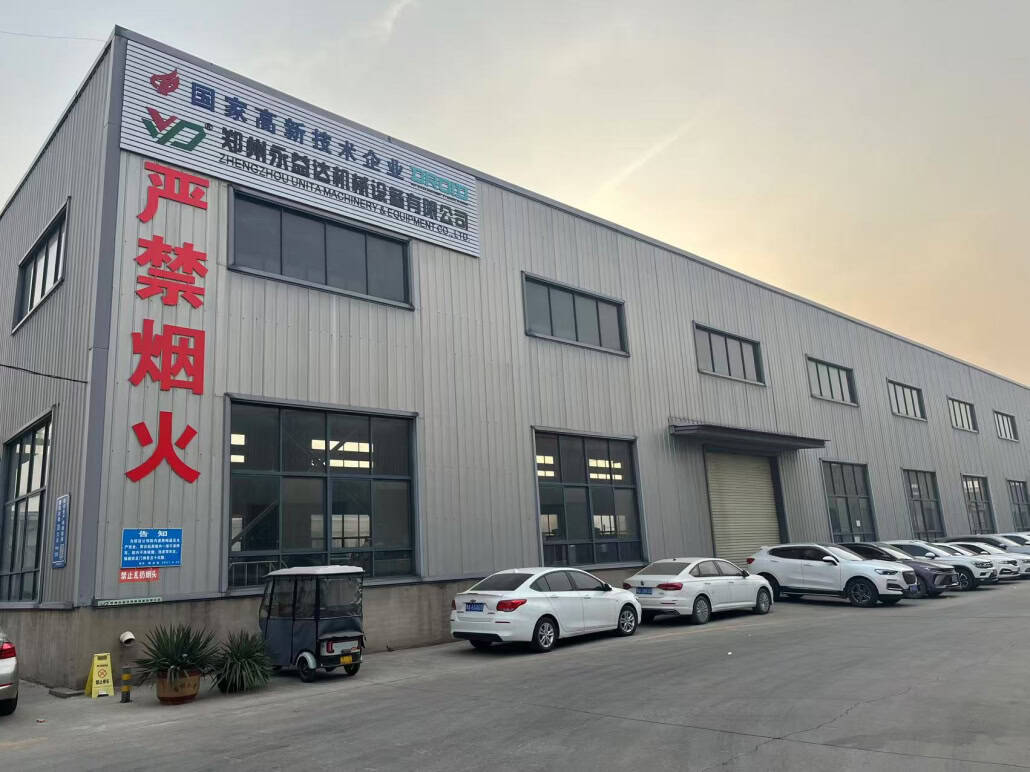
Wet Wipes Factory 1030x772 - How to Identify the Real Factory Behind a Wet Wipes Machine

Ask the Questions Traders Can’t Answer

Asking engineering-level questions is one of the quickest ways to determine whether a firm is a genuine manufacturer of wet wipes machines or a trading company. Since the individuals you are communicating with are either engineers themselves or are collaborating with them, a real manufacturer responds with confidence, clarity, and directness. Their responses are clear, consistent, and grounded in design reasoning rather than marketing jargon.

Begin by posing queries that delve into the machine’s inner workings rather than its outside appearance. For instance, who created the mechanism for folding and stacking? How is stress managed on various substrates? What adjustments are necessary if we alter the lotion’s viscosity or thicken the wipes? Which servo and PLC platform is in use, and what factors led to its selection? An actual manufacturer will explain the constraints, trade-offs, and logic. A trader may pause, respond ambiguously, or state, “We need to check with our engineer.”

When you inquire about changes, troubleshooting, or upcoming updates, the pattern becomes clear. Because they control the design, software, and assembly processes, real factories can explain what is feasible, what needs redesign, and what affects cost or lead time. Since they have no authority over the manufacturing, trading businesses are unable to commit. You are not working with the actual manufacturer if critical responses are slow or inconsistent, or if they are frequently sent through “another supplier.”

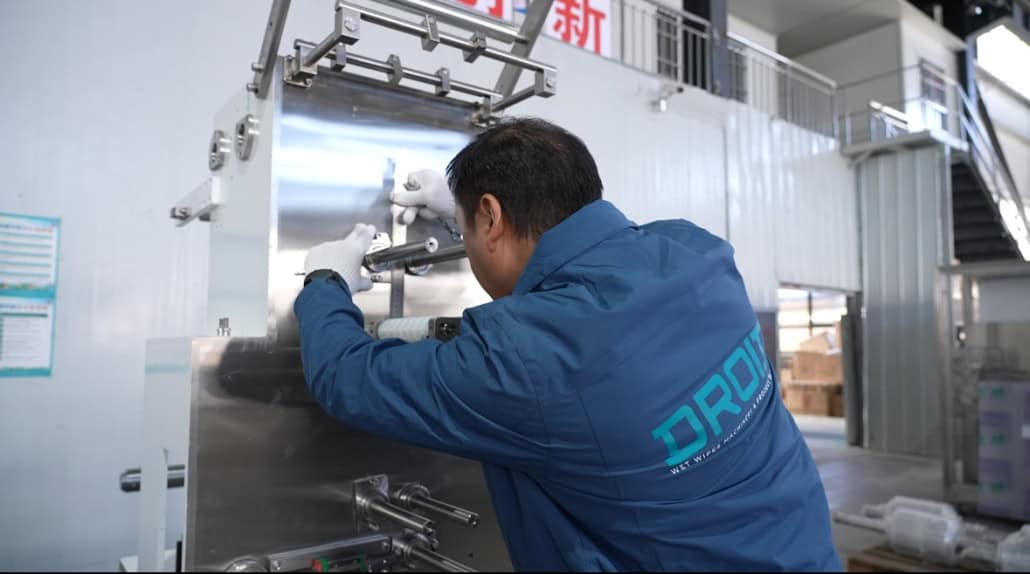
Wet wipes machine manufacturer 1030x574 - How to Identify the Real Factory Behind a Wet Wipes Machine

Verify Factory Ownership, Not Just a Business License

Since many trade organizations legitimately identify as “machinery manufacturers,” a business license is not always reliable as evidence of factory ownership. The business could appear genuine on paper, but in practice, it might not have a single machine design, engineer, or manufacturing line. One of the most frequent and expensive errors made by purchasers is to depend solely on registration documentation.

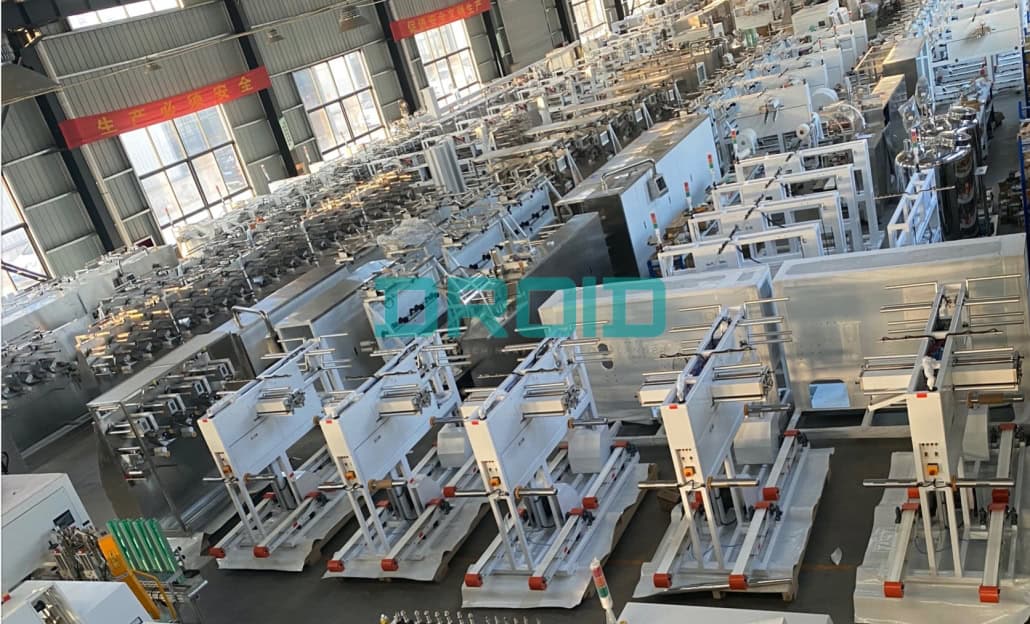
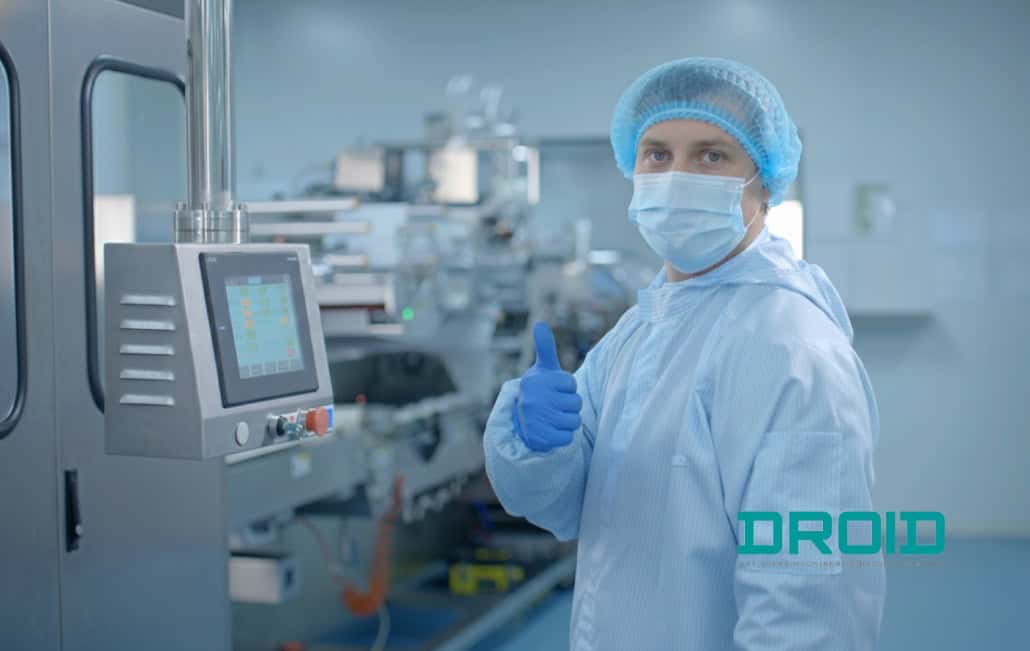
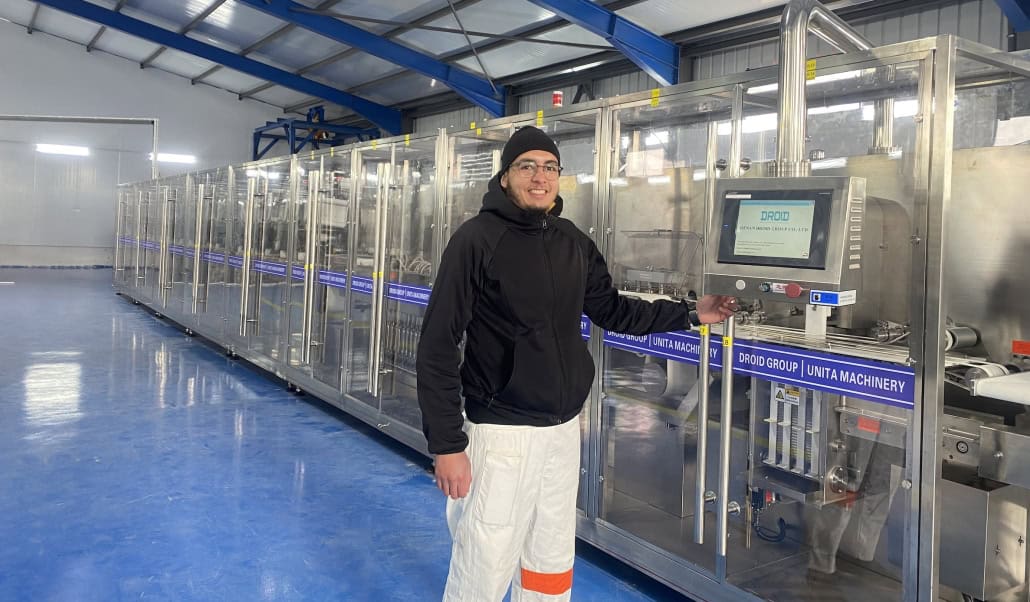
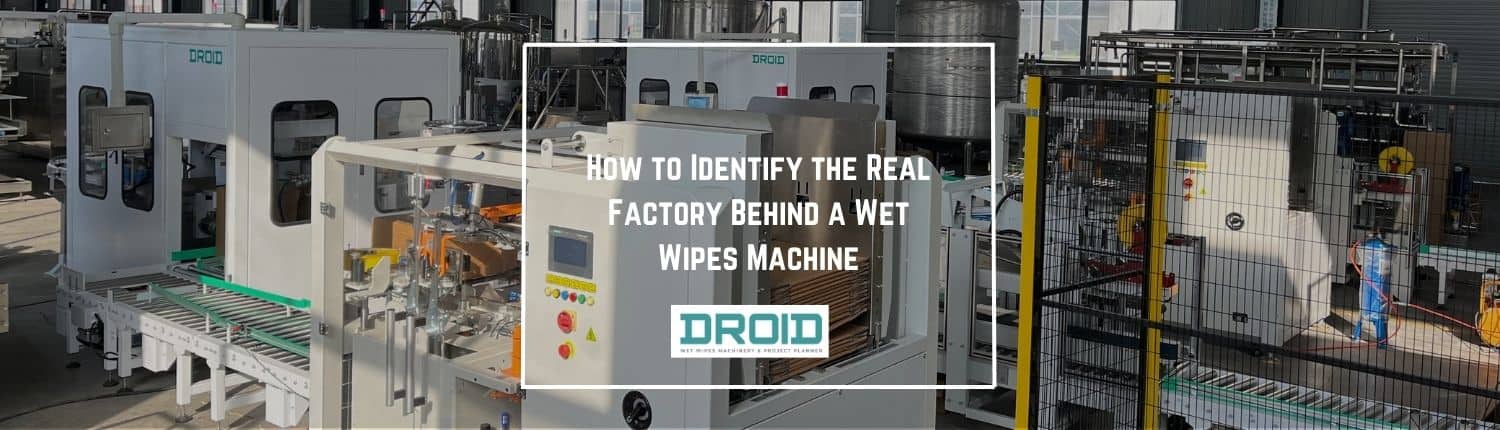
Look for tangible manufacturing proof rather than documentation to confirm actual factory ownership. Request live or recorded factory tour films that demonstrate the assembly lines, CNC machining, frame construction, electrical wiring, and testing sections. Multiple wet wipes machines being constructed concurrently with standardized components, a consistent design structure, and well-organized workstations are characteristics of a genuine factory. Trading businesses frequently steer clear of this, or display one loaned piece of equipment or a showroom.

Ownership is also evident in the people and procedures involved. Find out how many software, mechanical, and electrical engineers are employed inside, how quality control is organized, and how many projects are being produced concurrently. A genuine manufacturer may provide a detailed explanation of its delivery schedule, testing procedures, and manufacturing flow. A dealer is unable to do so as they have no authority over the factory. Ownership of industrial equipment entails accountability, and a license alone cannot demonstrate it.

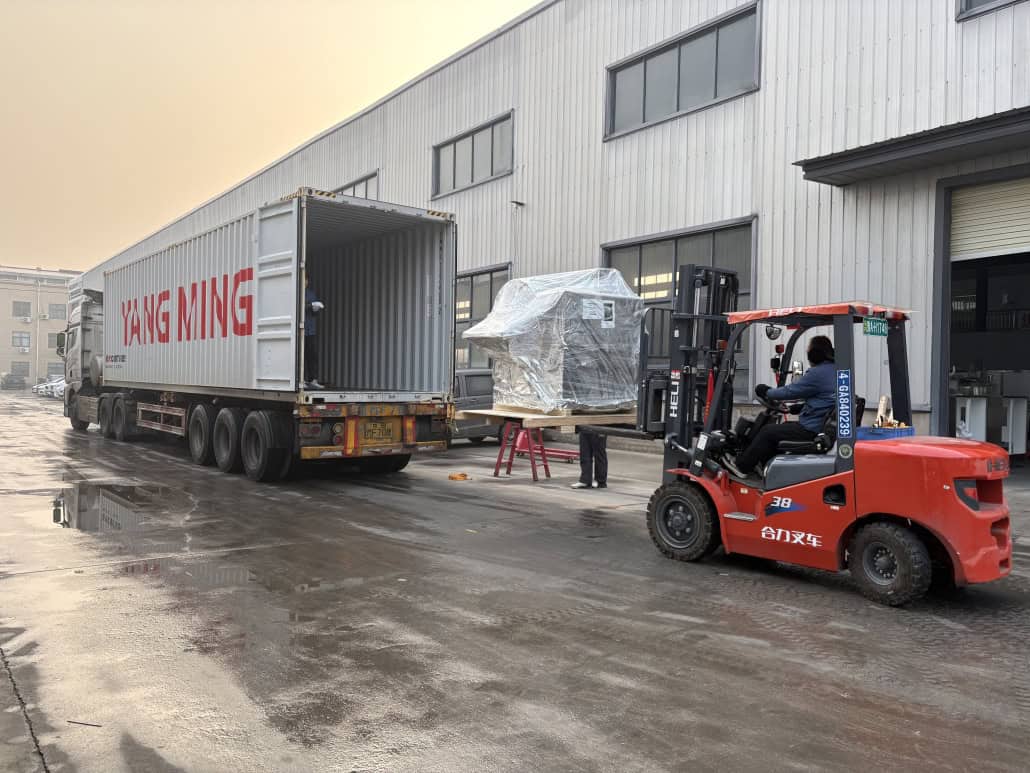
wet wipes machine manufacturer DROID 1 1030x773 - How to Identify the Real Factory Behind a Wet Wipes Machine

Look Beyond Speed Claims: Understand Real Performance

Speed is the most misused machine marketing metric in the wet wipes sector. “100, 120, or 150 packs per minute” is a claim that practically any seller can make; however, these numbers are often a short-term peak performance achieved during a quick demo under ideal conditions. However, real performance is determined by how regularly and steadily a machine operates throughout months of output, not by how quickly it can run for a few minutes.

An actual manufacturer explains the distinction between sustainable speed and theoretical speed. Sustainable performance accounts for servo load margins, temperature stability, material fluctuations, and mechanical wear during multi-shift operation. It also considers how the machine responds to various substrates, wipe sizes, liquid compositions, and packing materials. Without knowing the engineering constraints underlying the most significant figure, trading businesses usually replicate it.

Uptime, repeatability, and switching efficiency are further components of actual performance. Inquire about how long the machine can operate without assistance, how frequently it needs adjustment, and how quickly workers can move between formats without sacrificing quality. In actual production, a wet wipes machine that operates a little more slowly but still maintains alignment, sealing quality, and low reject rates would function better than a line that is quicker but less reliable. Buyers with experience understand that dependability and production per shift, not marketing speed promises, are the accurate indicators of performance.

wet wipes machine manufacturer DROID 4 1030x624 - How to Identify the Real Factory Behind a Wet Wipes Machine

Engineering Comes Before Steel

Many providers highlight sturdy constructions, substantial frames, and thick steel as indicators of excellence in wet wipes machines. Although mechanical strength is crucial, a machine’s performance is not only determined by steel. A wet wipes machine is not a static structure; rather, it is a dynamic system. Even the heaviest machine will struggle to produce consistent results if motion control, material management, and process coordination lack a strong technical rationale.

Before choosing materials, an actual manufacturer begins with engineering design. This comprises axis-to-axis motion synchronization, correct folding and stacking logic, precise tension management for nonwoven substrates, and synchronized cutting and sealing procedures. Steel thickness has no bearing on these factors; instead, servo programming, control algorithms, and mechanical layout do. When engineering is done right, even at higher speeds, the machine operates more consistently, with less wear and vibration.

Steel is simple to see and sell, thus trading businesses frequently sell “strong machines.” In contrast, unless you know what to ask, engineering is invisible. Inquire about the system’s response to material variation, tolerance management, and alignment maintenance over extended periods. A genuine maker may explain the reasoning for each movement. Steel helps performance in the manufacturing of wet wipes; engineering decides it.

wet wipes machine manufacturer DROID 2 1 1030x651 - How to Identify the Real Factory Behind a Wet Wipes Machine

Demand a Structured Production & FAT Process

One of the most apparent indicators of a legitimate wet wipes machine manufacturer is a systematic manufacturing and Factory Acceptance Testing (FAT) procedure. Industrial equipment is not constructed on the fly; instead, it is built using predetermined steps, recorded inspections, and controlled testing. The whole process of a project, from order confirmation to assembly, internal inspection, FAT, and final shipping, may be explained by a genuine factory.

The completion of mechanical assemblies, electrical wiring verification, software commissioning, dry-run testing, wet-run testing, and performance validation are all distinct production milestones that real manufacturers follow. Checklists, internal QC records, and duty assignments accompany each step. FAT, which is typically supported by reports, images, and test data, is an organized validation of speed stability, product quality, reject handling, alarms, and safety features. It is not a formality.

Trading firms sometimes view FAT as hurried or optional. Testing is shortened, left undocumented, or substituted with verbal guarantees since they have no control over the factory schedule. Instead of examining the data, buyers are urged to “trust experience.” Actually, a good FAT protects both parties by establishing a defined technical baseline before shipment, lowering commissioning risk, and verifying machine readiness. You are not working with a legitimate manufacturer if a supplier cannot provide a clear explanation of their production flow and FAT structure.

wet wipes machine manufacturer DROID 2 1030x602 - How to Identify the Real Factory Behind a Wet Wipes Machine

Compliance & Documentation Are Not Optional

Compliance and documentation are essential components, not add-ons, in the production of wet wipes. Regulations such as electrical standards, GMP-oriented hygienic design, and CE safety compliance have a direct impact on whether a manufacturing line can be built, audited, and operated lawfully for foreign purchasers. Instead of trying to address compliance difficulties after delivery, an actual wet wipes machine manufacturer understands these needs from the design stage and develops machines appropriately.

Engineering maturity and process discipline are reflected in appropriate documentation. Complete technical materials, such as risk assessments, electrical schematics, pneumatic diagrams, operation and maintenance manuals, spare parts lists, and safety instructions, are provided by a legitimate manufacturer. These papers are created internally, updated as the project progresses, and are technically compatible with the real machine. These aren’t generic templates that were made by third parties after the fact or taken from earlier projects.

Compliance is sometimes viewed by trading businesses as “paperwork to be arranged later.” They have no control over engineering or assembly; thus, paperwork might be delayed, erroneous, or inadequate, which could cause significant issues with certification, installation, or inspection. Inaccurate or missing paperwork might expose purchasers to legal risk, halt manufacturing, or delay market access. Wet wipes are an example of a regulated industry where a machine is incomplete if compliance and paperwork are lacking.

wet wipes machine manufacturer DROID 8 1030x773 - How to Identify the Real Factory Behind a Wet Wipes Machine

Evaluate the Support Model, Not the Sales Pitch

Support for quality in wet wipes machine projects is disclosed after delivery, rather than during negotiations. Sales presentations often make claims such as “24/7 service” or “full support,” but these claims are meaningless unless backed by an organized, transparent support mechanism. A genuine manufacturer creates its after-sales system with clear roles, engineering ownership, and long-term accountability, much as they do their machines.

Instead of having salespeople handle issues, a legitimate producer of wet wipes machines offers engineering-led help. Commissioning, training, optimization, and future updates are the responsibility of the machine’s engineers or engineers who have direct access to the original designs, PLC programming, and mechanical logic. Instead of using message relays or trial-and-error, this structure enables problems to be identified at the root cause level. Throughout the machine’s lifespan, support is proactive, documented, and constant.

Individual salespeople serve as the primary point of contact for trading firms. Technical inquiries are sent to outside factories after installation is complete, resulting in delays, a lack of accountability, and inadequate answers. Support frequently vanishes along with the salesman if they depart. The crucial concern for customers is not what is promised, but rather who will genuinely stand by your production in the event of issues. A solid support model is significantly more essential than a compelling sales pitch when it comes to industrial equipment.

wet wipes machine manufacturer DROID 5 1030x745 - How to Identify the Real Factory Behind a Wet Wipes Machine

Red Flags That Reveal a Trading Company

The lack of openness surrounding the facility itself is one of the most obvious indicators that it is a trading firm. Care should be taken if a supplier offers only one demonstration of equipment or a showroom, avoids live factory visits, or declines to provide in-depth walkthrough videos. Genuine manufacturers are often eager—and proud—to display their engineering teams at work, on the manufacturing floor, and with several pieces of equipment in assembly. A lack of genuine ownership is frequently indicated by avoidance.

Technical communication that is unclear or delayed is another serious warning sign. It indicates that the seller has little influence over design or manufacturing, as simple engineering concerns are routinely addressed with phrases like “we need to confirm with our engineer” or “our supplier will check.” An intermediary position rather than a manufacturing one is further revealed by inconsistent explanations, shifting requirements, or confusion regarding customization, FAT processes, or upgrade options.

Lastly, watch out for price-driven positioning that lacks firm long-term commitments. While downplaying lifetime expenses, spare parts availability, documentation quality, and after-sales structure, trading organizations frequently engage in fierce competition on upfront pricing. During negotiations, promises can seem appealing, but once made, they can be challenging to fulfill. The best signs that you are working with a trading firm rather than a legitimate producer of wet wipes machines are a lack of responsibility, poor engineering and ownership, and a short-term focus on sales.

wet wipes machine manufacturer DROID 9 1030x854 - How to Identify the Real Factory Behind a Wet Wipes Machine

Think Long-Term: Lifecycle, Not Delivery

A wet wipes machine purchase is a 10-year production lifetime decision, not a “delivery project.” When you’re managing many shifts, switching materials, modifying lotion recipes, onboarding new operators, or pushing capacity, many issues don’t arise within the first week of installation; instead, they manifest months later. Because of this, the actual cost of a machine is not the invoice price but rather the total cost of ownership, which includes uptime, reject rate, response time for spare parts, and the speed at which problems are resolved.

Since the manufacturer owns the engineering and accountability, an actual manufacturer supports the product throughout its lifespan. This entails consistent access to PLC programs, upgrade pathways, parameter settings, and original designs. It also includes organized assistance with commissioning, operator education, guidance on preventative maintenance, troubleshooting, and performance enhancement. If you want a different format, increased speed, a different pack size, or stricter standards, lifecycle-minded vendors can assess the request technically and execute it correctly rather than speculating.

Delivery-focused vendors, on the other hand, consider the project complete when the machine ships. Support depends on whoever happens to respond to messages; spare parts planning is reactive, and documentation may be scant. Production risk eventually results from this, including increased downtime, irregular output, and costly “patchwork fixes.” Because delivery is the first step in creating wet wipes, long-term customers choose partners who consider more than just shipping; lifecycle support is what keeps your company safe for years to come.

wet wipes machine0 1030x749 - How to Identify the Real Factory Behind a Wet Wipes Machine
Finding the actual factory that makes a wet wipes machine is not about being extremely careful; rather, it is about safeguarding your investment, the stability of your production, and the reputation of your business. Only real manufacturers can assume complete responsibility for engineering, quality, compliance, and long-term performance in an industry where numerous businesses can offer machines. The difference may not be evident in a quotation, but it becomes very clear over the years of operation.

You may shift from short-term convenience to long-term value by looking beyond business licenses, speed claims, and sales promises, and by asking questions about engineering ownership, production structure, FAT discipline, compliance preparedness, and after-sales support. These elements determine whether a machine becomes a consistent source of risk and unanticipated expenses or a dependable production asset.

In wet wipes manufacturing, success is built on systems, people, and accountability, not intermediaries. Because delivery is only the start and accountability lasts for years, pick a partner who owns the plant, the technology, and the equipment for the duration of its existence.

Verify engineering ownership, request factory films, and pose technical queries.

Traders don’t have long-term responsibility or engineering control.

Indeed. Scale reflects stability, QC systems, and manufacturing capability.

Yes. Customization requires in-house engineering and software ownership.

CE files, schematics, manuals, FAT reports, and spare parts lists.

No, peak claims are less important than consistent, repeatable speed.

Usually limited and delayed, as support depends on third parties.

Very important. Performance is verified by FAT prior to shipment.

Usually not. Upgrades and downtime raise the overall cost of ownership.

Engineering ownership and long-term support capability.

Ask For A Quote 

1 + 3 = ?

Contact Form